The Family Math Night: Turning Education Into Family Time
By Totally Medieval · September 17, 2026 · Math, Games, Family
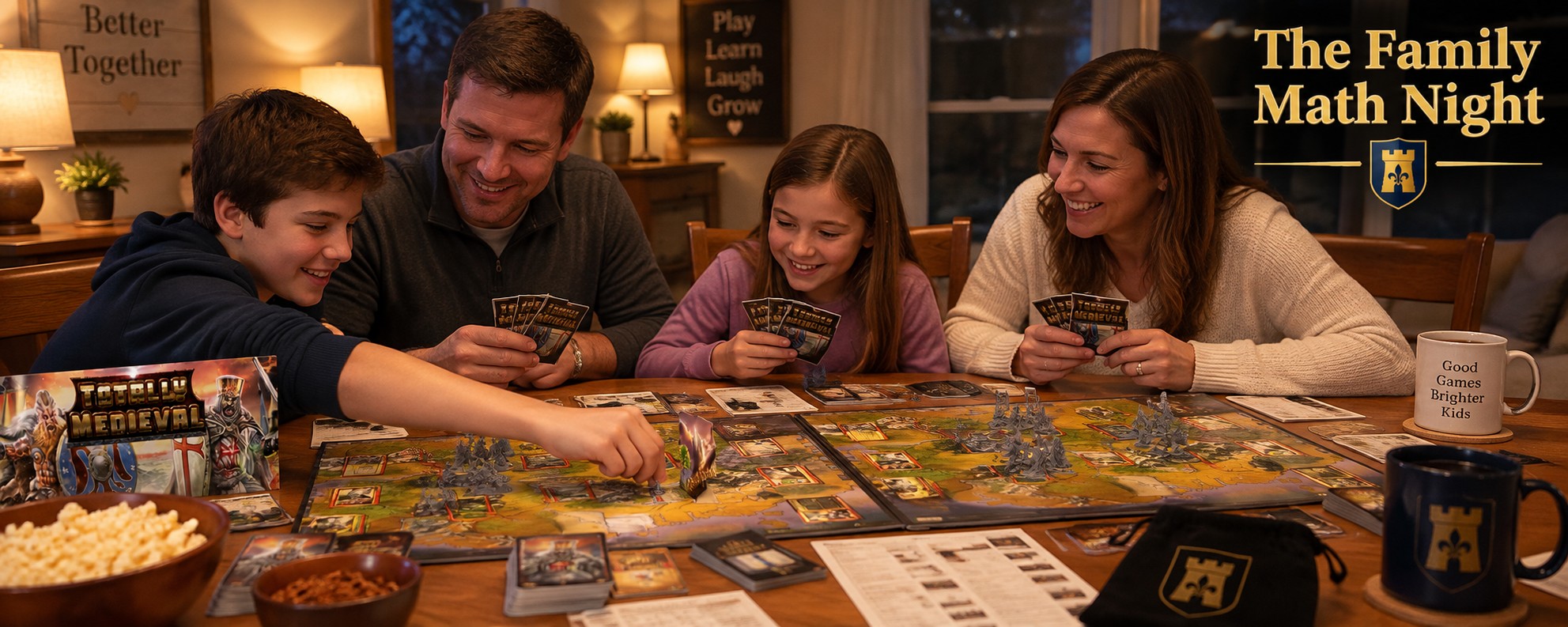
Math practice does not always have to mean one child, one textbook, and one worksheet. That is what I was taught in the public school. For homeschooling families especially, education can become something bigger: an opportunity to spend meaningful time together.
When children are young, they often idolize their parents. Mom and Dad seem to know everything. Children want our attention, approval, help, and time. They follow us around, ask endless questions, and want us to watch what they are doing.
Then they get older.
As parents, we naturally encourage independence. We tell them to take out a chair and reach the top shelf, finish their schoolwork on their own, solve their own problems, and take greater responsibility for themselves. That's part of growing up. But sometimes we push independence so successfully that we unintentionally create distance.
Our children don't stop looking for answers. They simply begin looking somewhere else.
Friends, teachers, coaches, social media, celebrities, online communities, and other influences increasingly become sources of information and ideas, and not good information. That's also a normal part of growing up. The goal isn't to prevent children from encountering other perspectives. The goal is to make sure Mom and Dad remain part of the conversation.
One simple way to do that is to keep doing things together—even as your children get older.
Math Can Become Family Time
Parents, especially those in homeschooling, have an unusual opportunity because learning doesn't have to be separated from family life. Unfortunately, we can still fall into the same routine:
"Here's your math." "Finish these pages." "Come get me if you need help."
That's efficient, but it also turns education into something the child does alone and does not seem to like.
What if one math lesson each week became a family activity instead?
Put away the phones. Grab a snack. Bring everyone to the table and play a game involving mathematics, strategy, numbers, money, measurement, probability, or problem-solving. And parents should play too.
Don't stand over your children correcting them. Sit across from them and become another player. Let your children challenge you.
When Dad gets a problem wrong, everybody can laugh. When Mom loses the game, the kids can celebrate. When a child who has been struggling with multiplication suddenly defeats an adult, that accomplishment means something.
Math becomes something the family experiences together.
You're Teaching More Than Mathematics
I've seen something interesting happen while families and children play educational games: they start talking.
They joke. They compete. They explain strategies. They complain about losing. They celebrate winning. They tell stories.
Sometimes a conversation about a game becomes a conversation about something completely unrelated.
That's valuable.
Research supports the broader importance of regular family interaction. The CDC identifies family connectedness, discussing problems with parents, shared parent-child activities, and consistent parental presence as protective factors for young people. CDC research has also found that higher parental monitoring is associated with lower prevalence of several adolescent risk behaviors and negative experiences. Importantly, the CDC emphasizes that monitoring works best within caring relationships where teenagers feel comfortable talking with their parents. CDC Youth Violence Risk and Protective Factors CDC Research on Parental Monitoring
That doesn't mean a weekly family game guarantees that a teenager won't rebel or make poor decisions. Parenting isn't that simple. But maintaining a strong relationship gives parents more opportunities to listen, guide, understand, and remain involved as their children become increasingly independent.
Independence should not have to mean disconnection.
Don't Wait for Family Time—Schedule It
One of the biggest problems facing families isn't necessarily that parents don't value family time. It's that everybody is busy.
Work. School. Sports. Activities. Phones. Appointments. Errands.
Family time gets whatever is left over.
Instead, schedule it.
Try This This Week: The 30-Minute Family Math Night
You don't need to redesign your homeschool program. Start with 30 minutes.
- Pick one night. Make it a regular part of your week.
- Put away the phones. Parents included.
- Bring snacks. Make the experience feel different from another school lesson.
- Choose a game or challenge. Incorporate arithmetic, fractions, algebra, money, probability, measurement, or whatever your children are learning.
- Match the difficulty to each child. A 9-year-old and a 15-year-old can participate in the same activity without solving the same problems.
- Parents play too. Don't become the teacher or referee for the entire game.
- Let children challenge adults. Give them an opportunity to demonstrate what they know.
- Talk while you play. Don't become so focused on mathematics that you miss the conversation happening around the table.
Most importantly, repeat it next week.
Thirty minutes every week becomes roughly 26 hours together over a year.
That's 26 hours of games, conversation, laughter, competition, mathematics, mistakes, victories, and memories that wouldn't exist if everyone had simply gone to separate rooms.
Your Children Probably Won't Remember the Worksheet
Twenty years from now, your son probably isn't going to call and say, "Dad, remember worksheet 7B? What a great night."
He may remember beating Dad at a game.
He may remember everyone laughing when Mom got an easy problem wrong.
He may remember finally understanding fractions because his older sister showed him another way to think about them.
And he may remember something much more important:
My parents wanted to spend time with me.
That's why educational games can have value beyond the academic skill being practiced. Mathematics provides the challenge, but playing together provides an opportunity for relationships to grow.
Where Totally Medieval Fits In
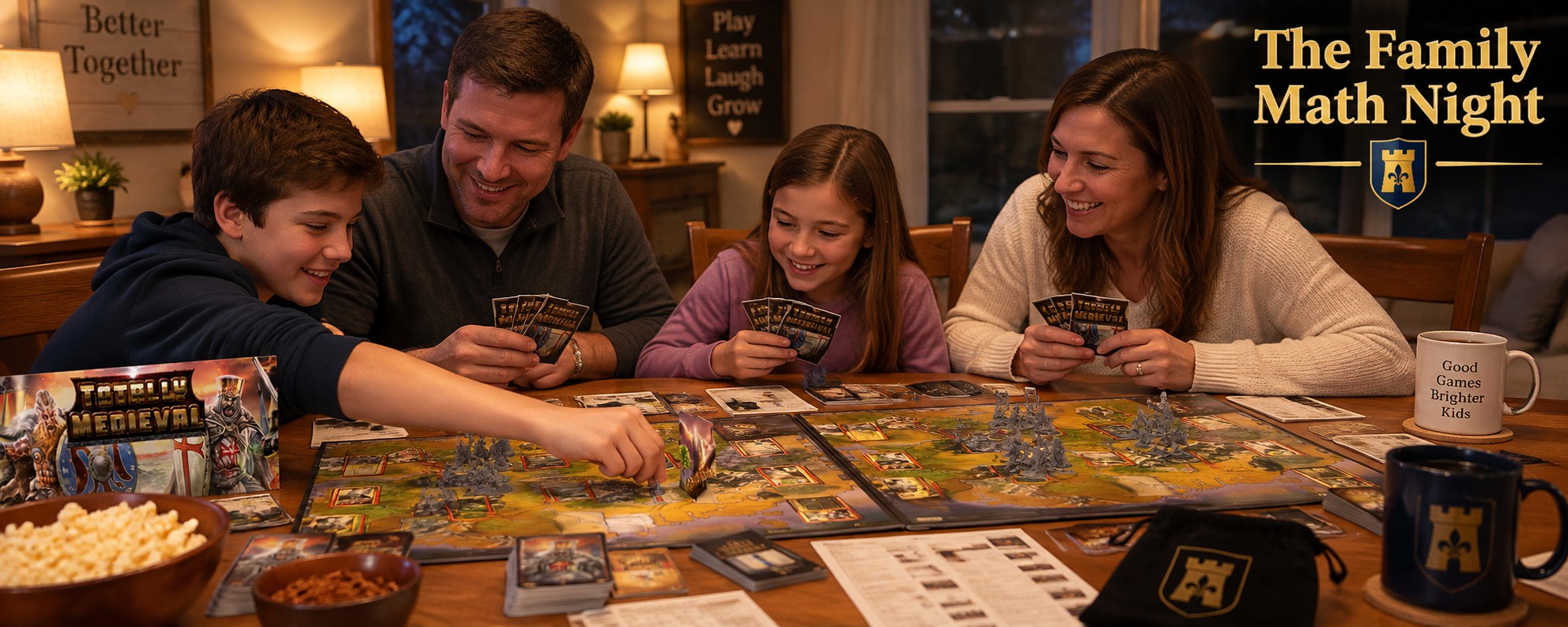
This philosophy is one of the ideas behind Totally Medieval.
Students use mathematics while moving across a game board, navigating terrain, developing strategies, and challenging opponents. Different students can play together while working at different mathematical levels, meaning a younger child and an older sibling don't necessarily need identical math skills to participate in the same adventure.
But one of the most important players may be you.
Sit down and play with your children.
Let them challenge you. Let them beat you. Help them when they're struggling. Laugh when somebody makes a ridiculous mistake. Celebrate when a child finally solves something that was difficult last week.
You're reinforcing mathematics, but you're also doing something that becomes increasingly important as children get older.
You're staying involved.
We spend plenty of time worrying about who and what will influence our children. One of the best things parents can do is continue building a relationship strong enough that their children still want Mom and Dad involved in their lives.
So start with something simple.
Thirty minutes. One night a week. Phones away. Family together. Math on the table. Game on.