Stop the Worksheets: How to Make Math Something Your Child Actually Wants to Practice
By Totally Medieval · August 15, 2026 · Curriculum, Math, Games
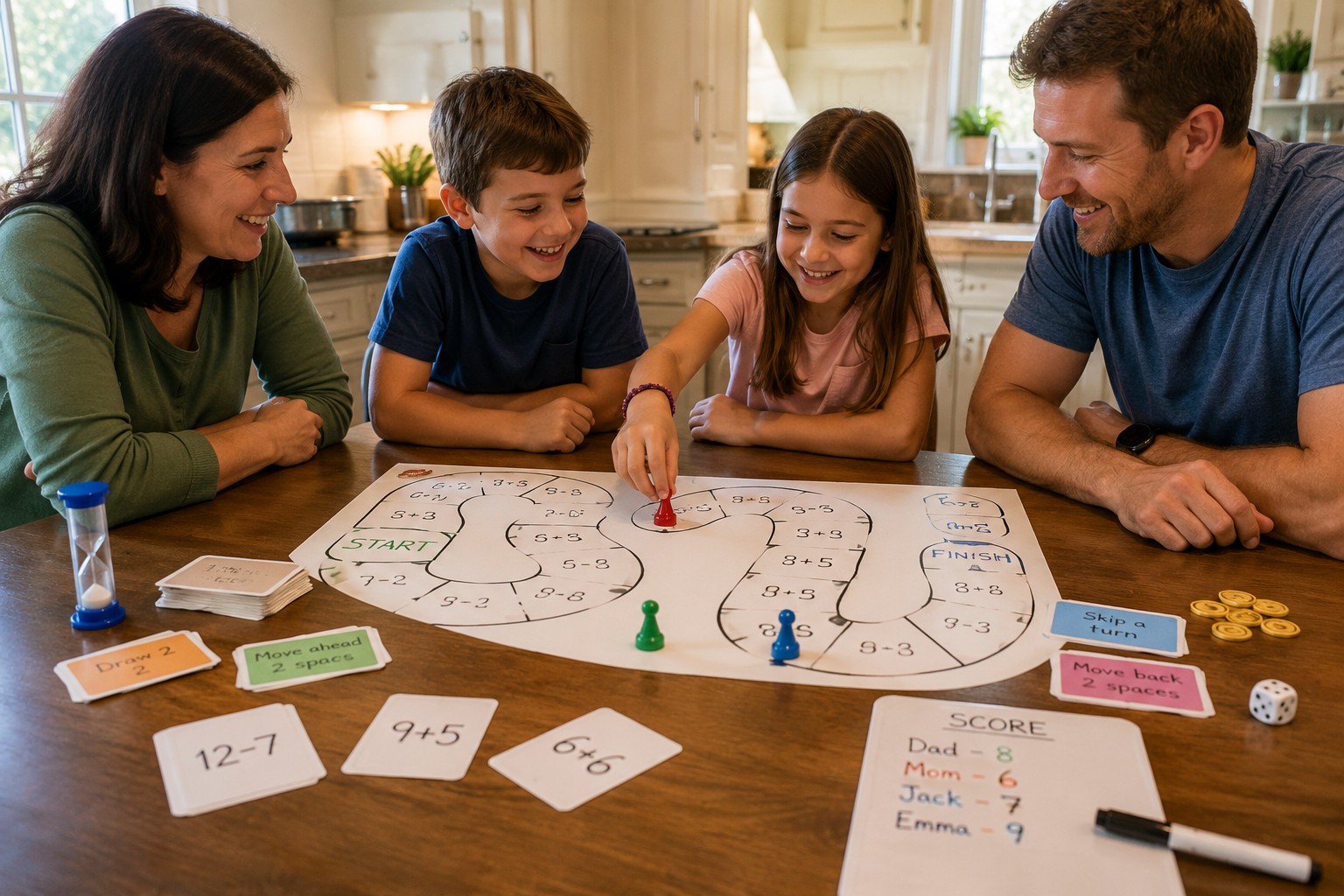
For many homeschooling parents and educators, the battle over math begins with a familiar sentence: “Do I have to do all of these problems?”
The surprising answer may be that the student does not actually dislike mathematics. He may dislike the way he is being asked to practice mathematics. There is an important difference.
Worksheets certainly have a place in education. Students need opportunities to work independently, demonstrate mastery, and practice procedures. But when math practice becomes page after page of nearly identical problems, students can begin to associate mathematics with repetition rather than discovery, problem-solving, or accomplishment. The goal should not simply be getting children to finish more math problems. The goal should be creating enough meaningful practice that mathematical skills become stronger, faster, and easier to retrieve when students need them.
For homeschool families, this presents an enormous opportunity. You have the flexibility to take the mathematics your child is already learning and change how that practice happens.
Practice Is Necessary—Boredom Isn't
Repetition matters in mathematics. A child learning multiplication facts, fractions, equations, or algebra cannot encounter a concept once and expect to master it forever. Students need repeated opportunities to retrieve and apply what they have learned.
The important question is: What should that repetition look like?
Research on learning strongly supports retrieval practice—the process of actively recalling previously learned information rather than simply reviewing it again. A major review of retrieval-practice research found substantial evidence that retrieving information can strengthen long-term learning. In other words, students benefit from having to produce an answer rather than simply looking at the material again.
That principle works beautifully with mathematics. The problem is not that students are being asked to practice. The problem comes when practice becomes so predictable and passive-feeling that students mentally disengage.
Imagine two students who each solve 20 multiplication problems.
One receives a sheet containing 20 equations and works down the page.
The other answers the same types of problems, but every correct answer allows her to move a game piece, earn resources, overcome an obstacle, challenge another player, or advance toward an objective.
Both students are practicing mathematics. Psychologically, however, those experiences can feel very different.
Research into game-based mathematics learning supports this distinction. A meta-analysis examining digital games and K–12 mathematics motivation concluded that games can be effective tools for promoting mathematics motivation compared with conventional instructional approaches.
The lesson for parents is not “throw away every worksheet.” It is much more useful:
Don't confuse repetition with worksheets.
Students need repetition. That repetition can take many forms.
Give the Math a Purpose
Children will often repeat difficult tasks voluntarily when those tasks are attached to something they want to accomplish.
Think about games. A child may attempt the same level repeatedly because he wants to beat it. He may calculate scores, manage resources, compare statistics, remember complicated rules, develop strategies, and analyze mistakes without anyone assigning those activities as homework.
The difference is purpose.
Instead of saying, “Solve these 10 problems because you need practice,” try creating a reason those answers matter.
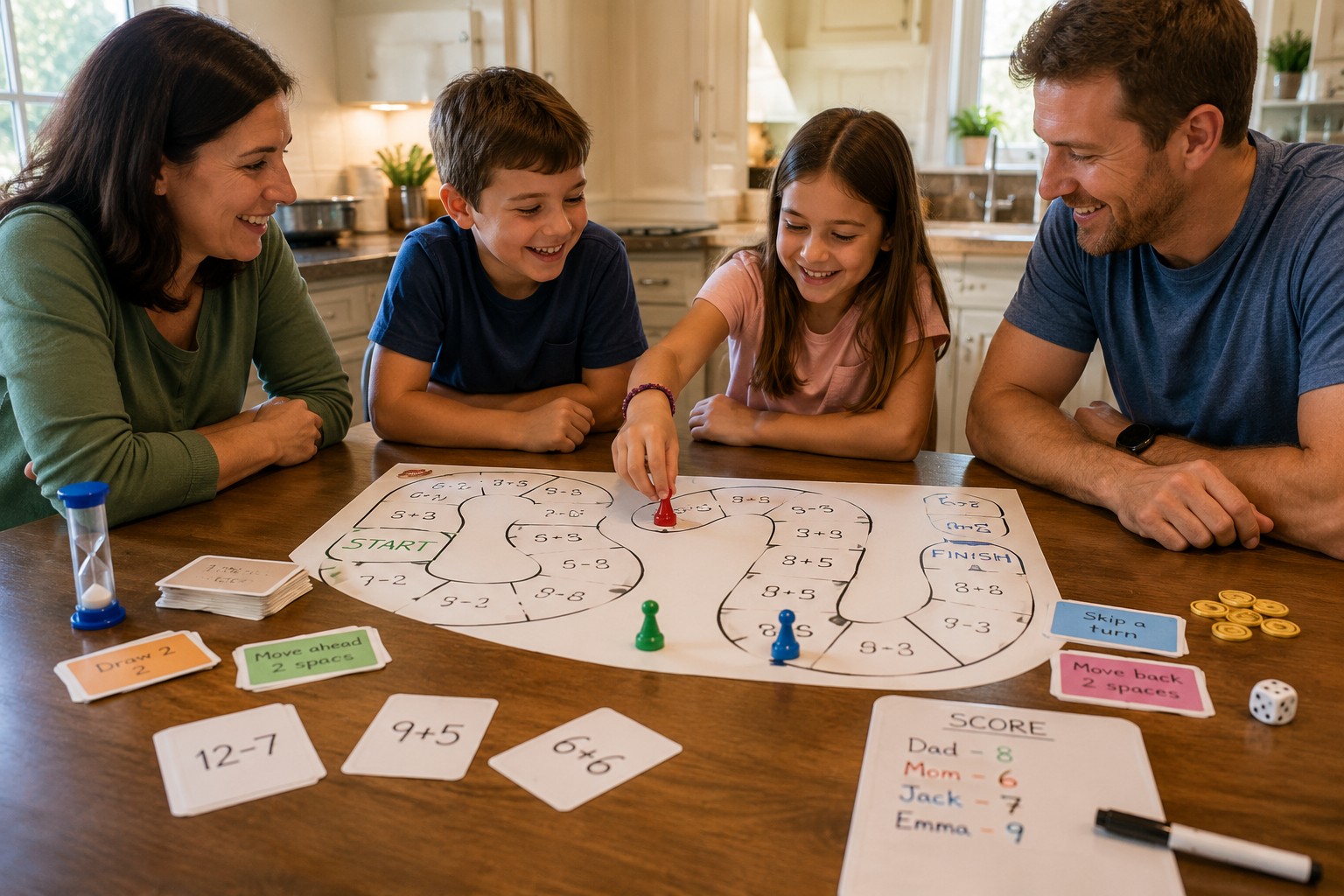
Correct answers might earn movement across a homemade map. They could earn building materials for a tower. They might allow a player to roll dice, draw cards, attack a castle, rescue an explorer, earn pretend money, or advance toward a finish line.
The mathematics has not disappeared. In fact, the student may end up completing more mathem
atics because the problems have become obstacles standing between the student and something he wants to accomplish.
Motivation Matters More Than We Sometimes Realize
Self-Determination Theory provides another useful framework for understanding student motivation. Research in education has repeatedly examined three important psychological needs: autonomy, competence, and relatedness. A 2024 systematic review and meta-analysis of 36 Self-Determination Theory-based educational interventions found improvements in intrinsic motivation, autonomy, and competence.
This gives homeschool parents three powerful questions to ask about math practice:
Does my child have any choice?
Does my child regularly experience success and recognize that he or she is improving?
Does math ever involve interaction with parents, siblings, friends, or other students?
A worksheet can provide useful independent practice, but it does not automatically provide these motivational ingredients. A game or challenge can make it much easier.
For example, allow the student to choose between two categories of problems. Let the student choose which opponent to challenge. Create different difficulty levels worth different numbers of points. Let siblings play at their own math levels while participating in the same competition.
Suddenly, students aren't simply completing math. They are making decisions with math.
Turn Ten Problems Into a Challenge
Here is something parents can try immediately.
Take 10 problems from today's math lesson. They can be addition, multiplication, fractions, decimals, geometry, pre-algebra, or algebra.
Don't change the mathematics.
Change what happens after the answer.
Put a game piece at one end of the kitchen table and create a finish line at the other. Every correct answer moves the piece forward one space.
Or give each correct answer a certain number of imaginary gold coins. At the end, allow the student to spend those coins on materials needed to construct a LEGO castle.
Create a race between siblings. Give harder problems higher point values. Hide problems around the room. Have students answer correctly before advancing to the next location.
You can even create a family competition where Mom or Dad participates.
The objective is simple: Make the mathematics necessary for accomplishing something else.
Action Item: The 10-Problem Challenge
Today, take 10 problems your child would normally complete on paper.
Then choose one:
- Each correct answer moves a game piece one space.
- Each answer earns resources for building something.
- Hide the problems around the house and create a math scavenger hunt.
- Let students choose between easy, medium, and difficult problems for different point values.
- Create a parent-versus-student competition.
- Give students 10 minutes to defeat a fictional opponent by correctly solving problems.
Don't increase the workload. Change the experience.
Get Students Moving
Math does not always have to happen while sitting at a desk.
Movement can be particularly helpful when students have been sitting for extended periods. A systematic review of classroom movement breaks and physically active learning found that these interventions increased physical activity and often improved classroom behavior and time on task, although the researchers cautioned that evidence for direct improvements in cognition or academic performance was limited.
That distinction is important. Parents should not assume that jumping while practicing multiplication will magically increase math achievement. Movement can, however, help break up sedentary learning and may improve students' readiness to stay on task.
Try placing answer cards around the room. Call out a problem and have the child move to the correct answer.
Put numbers on the floor and have younger children jump to answers.
Create a giant number line.
Send students on a scavenger hunt where each solved equation reveals the location of the next problem.
Math suddenly becomes something students do rather than simply something they fill out.
Turn Mistakes Into Part of the Game
Games also change our relationship with failure.
When children lose a board game, miss a basketball shot, or fail to complete a video-game level, they often immediately want another attempt. Yet one incorrect math problem can sometimes produce frustration.
Parents can borrow the retry mentality of games.
Instead of simply placing an X beside an incorrect answer, say, “That one stopped you. Find out why.”
Allow a correction to recover a lost point.
Give students a second attempt for partial credit.
Let them explain their mistake to earn another turn.
The message changes from “You failed the problem” to “Your strategy didn't work yet. Figure out what happened and try again.”
That is a powerful mathematical habit because higher-level mathematics increasingly requires persistence and problem-solving rather than instant answers.
Let Children Compete—But Don't Make Winning Everything
Competition can be motivating for some students and discouraging for others, so parents should use it thoughtfully.
Competition does not always have to mean child versus child.
Students can compete against themselves.
“How many can you solve correctly in five minutes?”
“Yesterday you earned 14 points. Can you beat 14 today?”
“Can our whole family earn 100 points together?”
You can also create cooperative challenges. Perhaps everyone is trying to accumulate enough correct answers to defeat a fictional dragon before time expires.
This preserves the excitement of a challenge without making the strongest math student the permanent winner.
The goal is engagement with mathematics, not proving who is smartest.
A Simple Math Makeover You Can Start This Week
Parents do not need to purchase an entirely new curriculum to experiment with these ideas. Keep teaching the mathematics your curriculum requires. Simply change some of the practice.
This week, try replacing one traditional practice session with a 20-minute Math Challenge.
Spend five minutes reviewing the concept. Spend 10 minutes playing a game or challenge that requires students to retrieve and apply the skill. Spend the final five minutes asking the student to explain two or three answers.
Then ask one final question:
“Would you rather practice that way again or do another worksheet?”
Listen carefully to the answer.
If your child voluntarily wants another round, you have discovered something incredibly valuable: practice no longer feels quite so much like practice.
Bringing Math Into an Adventure with Totally Medieval
This same philosophy is behind Totally Medieval. Instead of making the game a reward students receive after completing mathematics, Totally Medieval places mathematics within the adventure itself.
Players move across a game board toward their opponents, navigate different terrains, make strategic choices, and engage their opponents through mathematical challenges. The math has a purpose within the game: students solve problems because those problems help them advance, compete, and accomplish their objectives.
An especially useful feature for homeschool families is the ability for students at different mathematical levels to participate in the same experience. One child might be practicing addition while an older sibling is working with more advanced mathematics. They do not necessarily have to complete identical math problems to share the same game experience.
This creates additional opportunities for the repeated retrieval and application that students need while surrounding that practice with strategy, competition, decision-making, and interaction. Research on game-based mathematics learning suggests that well-designed games can support student motivation, while broader motivation research emphasizes the value of competence, autonomy, and relatedness.
Totally Medieval is therefore not about eliminating math practice. It is about changing what practice can feel like.
The next time your child groans when you place another worksheet on the table, don't immediately assume the problem is mathematics. Take those same 10 problems and give them a purpose. Turn them into movement. Turn them into decisions. Turn them into a challenge.
You may discover that the child who says, “I hate practicing math,” is willing to solve the same kinds of problems again and again when those answers finally lead somewhere.