"Don't Make Me Repeat Myself" - (Signed) History
By Historical Conquest LLC · July 28, 2026 · History, Curriculum, Reading
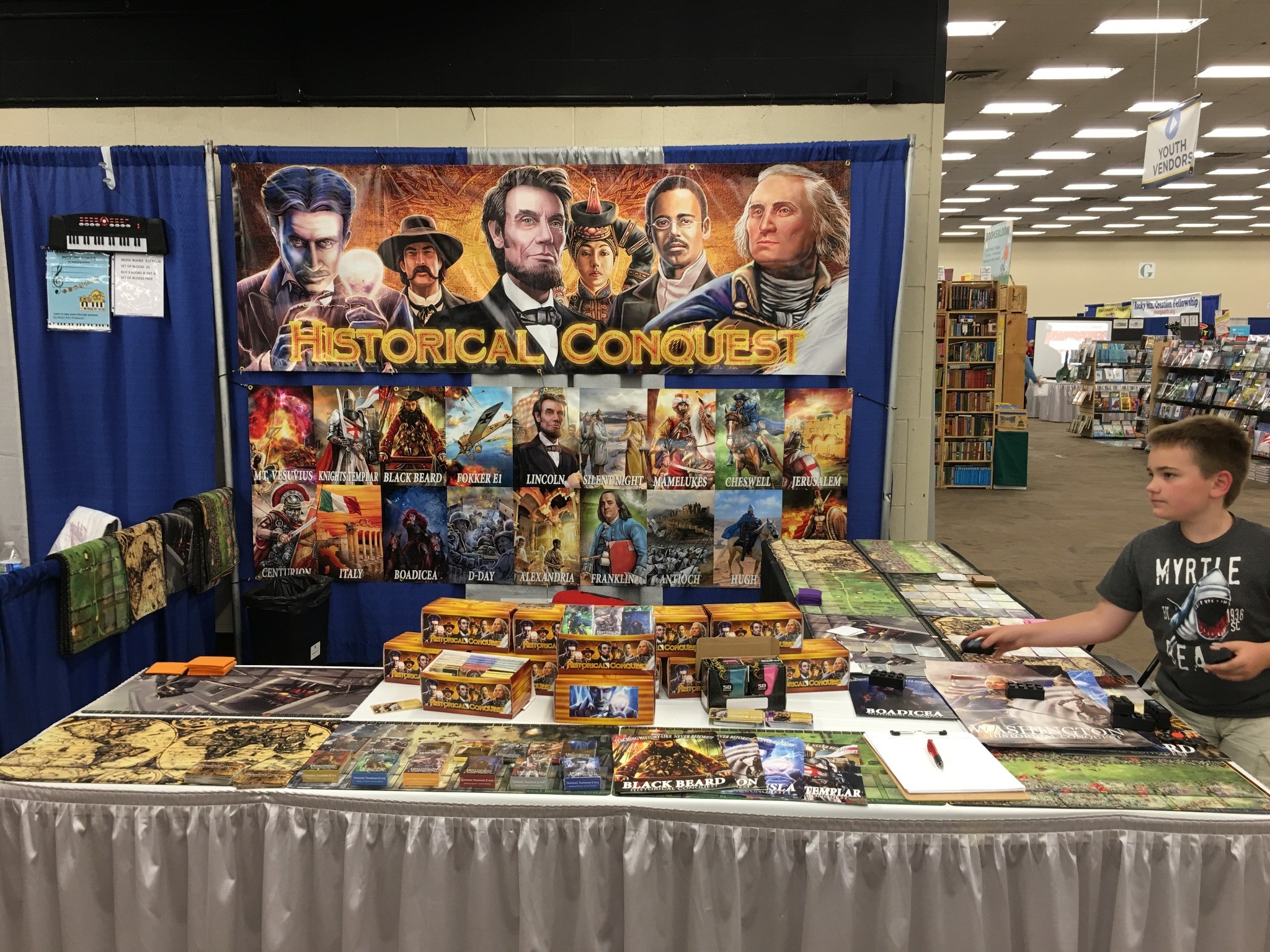

Every homeschooling convention and educational conference seems to begin the same way for me. I unpack my booth, arrange the Historical Conquest games, set up our curriculum, and put on one of two T-shirts that have become conversation starters wherever I go.
On the first day, my shirt reads:
"Don't Make Me Repeat Myself – (Signed) History."
On the second day, I wear another favorite:
"Really, Again! – (Signed) History."
Without fail, people stop. They laugh. They point. They tell stories. Teachers share examples from their classrooms. Parents talk about current events. Veterans remember lessons learned in war. Grandparents compare today's headlines with events they lived through decades ago. Before long, complete strangers are discussing one simple but powerful phrase:
"History repeats itself."
That conversation happens over and over again, and every time it reminds me why history matters more today than perhaps at any point in modern life.
The phrase "history repeats itself" is often misunderstood. History rarely repeats itself exactly. Some people have changed the phase now to say “History doesn’t repeat itself, but it definitely rhymes.
The names change. The countries change. The technology changes. But human nature changes very little. Pride, fear, greed, courage, innovation, selfishness, sacrifice, ambition, and hope have driven civilizations for thousands of years. The settings may look different, but the motivations often remain remarkably familiar.
Every generation believes it is experiencing problems that are completely unique. Yet when we open the pages of history, we discover people wrestling with many of the same questions. Economic uncertainty. Political division. The spread of misinformation. Wars. Disease. Technological revolutions. Questions about freedom and responsibility. Conflicts between cultures. The challenge of balancing security with liberty. These are not exclusively modern problems—they are recurring chapters in the human story.
Even politics. Don’t worry, I am not talking politics here exactly, instead, I want everyone to remember the Revolution of 1800. It is known as the worst election process of time. Rhetoric was actually worse than the two parties throwing jabs. Politics have always been nasty, even nastier in the past.
That is why history is not simply about memorizing dates or identifying famous people. History is humanity's laboratory. It is thousands of years of experiments showing what happens when societies embrace wisdom—and what happens when they abandon it.
The greatest civilizations did not become great by accident. They built institutions that rewarded hard work, innovation, education, personal responsibility, and strong communities. Likewise, many powerful civilizations did not collapse overnight. They weakened gradually through poor leadership, corruption, economic instability, internal division, military overreach, or the loss of civic responsibility. The warning signs were often visible long before the collapse came.
Students who understand these patterns develop something far more valuable than historical knowledge—they develop historical judgment. Instead of reacting emotionally to every headline, they begin asking better questions.
"Have we seen something like this before?"
"What happened the last time a nation faced similar challenges?"
"What decisions helped?"
"Which decisions made things worse?"
These questions transform history from a collection of old stories into a practical guide for living.
One of the greatest dangers in the modern world is that we are surrounded by information but often lack perspective. Every day, students scroll through thousands of opinions, headlines, videos, and social media posts. Information moves faster than ever before, but wisdom still develops slowly. Without historical context, it becomes difficult to separate temporary excitement from lasting truth.
History Provides that Context
When students understand how propaganda has influenced populations throughout history, they become more careful consumers of modern media. When they study inflation, financial crises, and economic recoveries from the past, they gain a better understanding of today's economic discussions. When they examine both successful and failed governments throughout history, they become more thoughtful citizens. When they study diplomacy and war, they better appreciate the value of peace while recognizing the importance of defending freedom.
History Teaches Discernment
It reminds us that slogans are not always solutions. Popular ideas are not always wise ideas. Loud voices are not always correct voices. Every generation believes it has discovered something entirely new, yet history quietly reminds us that similar promises—and similar mistakes—have appeared many times before.
The encouraging news is that history does more than warn us. It inspires us.
For every tyrant, history introduces courageous reformers. For every war, it reveals peacemakers. For every failure, it celebrates inventors, entrepreneurs, scientists, explorers, teachers, missionaries, and ordinary citizens who changed the course of history through determination and character. Students discover that individuals truly can make a difference.
That is one reason social studies remains so essential. It combines history, geography, economics, government, and culture into a single discipline that helps students understand how societies function. It teaches not only where we have been but also why the world works the way it does today.
Unfortunately, many students experience history as a list of disconnected facts to memorize before a test. Names are forgotten. Dates disappear. Interest fades. Yet history was never meant to be learned that way.
History is a story.
It is filled with heroes and villains, victories and defeats, inventions and disasters, courage and cowardice, triumph and tragedy. The more students become immersed in those stories, the more they remember them—and the more they begin connecting them to the world around them.
That belief is at the heart of what we strive to accomplish at Historical Conquest.
Our goal has never been simply to create another educational game. Our mission is to help students retain history in a way that sparks lifelong curiosity. When students play, they encounter historical figures, civilizations, inventions, battles, discoveries, and events. They naturally begin asking questions.
"Who was this person?"
"What happened next?"
"Why did this civilization rise?"
"Why did it fall?"
Those questions are exactly what we hope to inspire because genuine learning begins with curiosity. When students choose to investigate history on their own, they move beyond memorization into understanding. They begin connecting historical events across centuries, recognizing patterns, and thinking critically about the world around them.
Our hope is that students leave with more than knowledge of the past. We hope they develop wisdom for the future. We hope they recognize both the incredible achievements humanity is capable of and the costly mistakes that should never be repeated.
Perhaps that is why those two T-shirts continue to start conversations year after year.
"Don't Make Me Repeat Myself – (Signed) History."
"Really, Again! – (Signed) History."
They make people smile, but they also carry a serious message.
History has been speaking to humanity for thousands of years.
The real question is whether we are finally willing to listen.