College, Trade School, or Straight into a Career? Helping Your Student Find the Right Path
By Innovate the Future · July 22, 2026
There Is No Single Road to Success
For generations, many families have been told that there is only one path to success: graduate from high school, attend college, earn a degree, and build a career. While that path has opened countless doors for millions of people, today's world offers more opportunities than ever before. Students can earn college degrees, master skilled trades, build successful businesses, join apprenticeships, serve in the military, or begin careers immediately after high school.
The challenge for parents is not deciding which option is "best." The challenge is discovering which option is best for their child. Every student is different. Every family is different. Every career is different.
Helping students discover the path that fits their talents, interests, personality, and goals may be one of the most important decisions a family ever makes.
College Is a Wonderful Opportunity—but It Isn't the Only One
College remains an outstanding choice for many students. Careers in medicine, engineering, law, education, architecture, accounting, scientific research, and many other professions require advanced degrees. Even in careers where a degree is not legally required, college can provide valuable knowledge, networking opportunities, internships, and personal growth.
Research consistently shows that, on average, individuals with bachelor's degrees earn more over their lifetimes than those whose education ends with high school. The U.S. Bureau of Labor Statistics has also found that college graduates generally experience lower unemployment rates than workers without degrees.
A college degree can also serve as a safety net.
Life rarely goes exactly as planned. Someone may begin one career and later decide to change directions. Having a degree often opens additional opportunities that might not otherwise be available. Even if graduates never work directly in the field they studied, many employers value the problem-solving, communication, and perseverance that earning a degree demonstrates.
For many students, college is absolutely the right choice. But not for every student.
Trade Schools Are Building the Future
While college often receives most of the attention, skilled trades continue to offer outstanding careers with strong earning potential.
· Electricians.
· Plumbers.
· HVAC technicians.
· Welders.
· Construction managers.
· Diesel mechanics.
· Automotive technicians.
· Machinists.
· Medical technicians.
These careers are essential to society, and demand for many skilled trades remains high.
Trade schools generally require less time than a four-year degree, cost significantly less, and often allow students to begin earning full-time incomes much earlier. Some of these jobs these days start have a start off pay of over
Many skilled trades also provide opportunities to start independent businesses, creating even greater financial potential for those willing to work hard and develop leadership skills.
Trade school should never be viewed as a "backup plan." For many students, it is exactly the right plan.
Entrepreneurship Is Another Path
Not every student dreams of working for someone else. Some dream of building something of their own.
Today's entrepreneurs have opportunities that previous generations could hardly imagine.
· Online businesses
· Landscaping companies
· Software development
· Content creation
· Consulting
· Manufacturing
· Home services
Countless other industries allow motivated individuals to build successful companies without first earning a college degree. That does not mean entrepreneurship is easy.
Running a business requires discipline, financial management, customer service, marketing, leadership, problem-solving, and resilience. Many businesses fail. And yet, many succeed.
For students with strong entrepreneurial instincts, beginning early can provide years of valuable experience before many of their peers have even graduated college.
For example: by the time a student studying law or medicine gets out, they are eight years older and nearly one million dollars in debt. At the same time, someone who started a successful lawn care business can be making
One Family, Four Different Paths
Our own family has taught us that there is no one-size-fits-all answer. We have four children, and each one is incredibly intelligent in completely different ways.
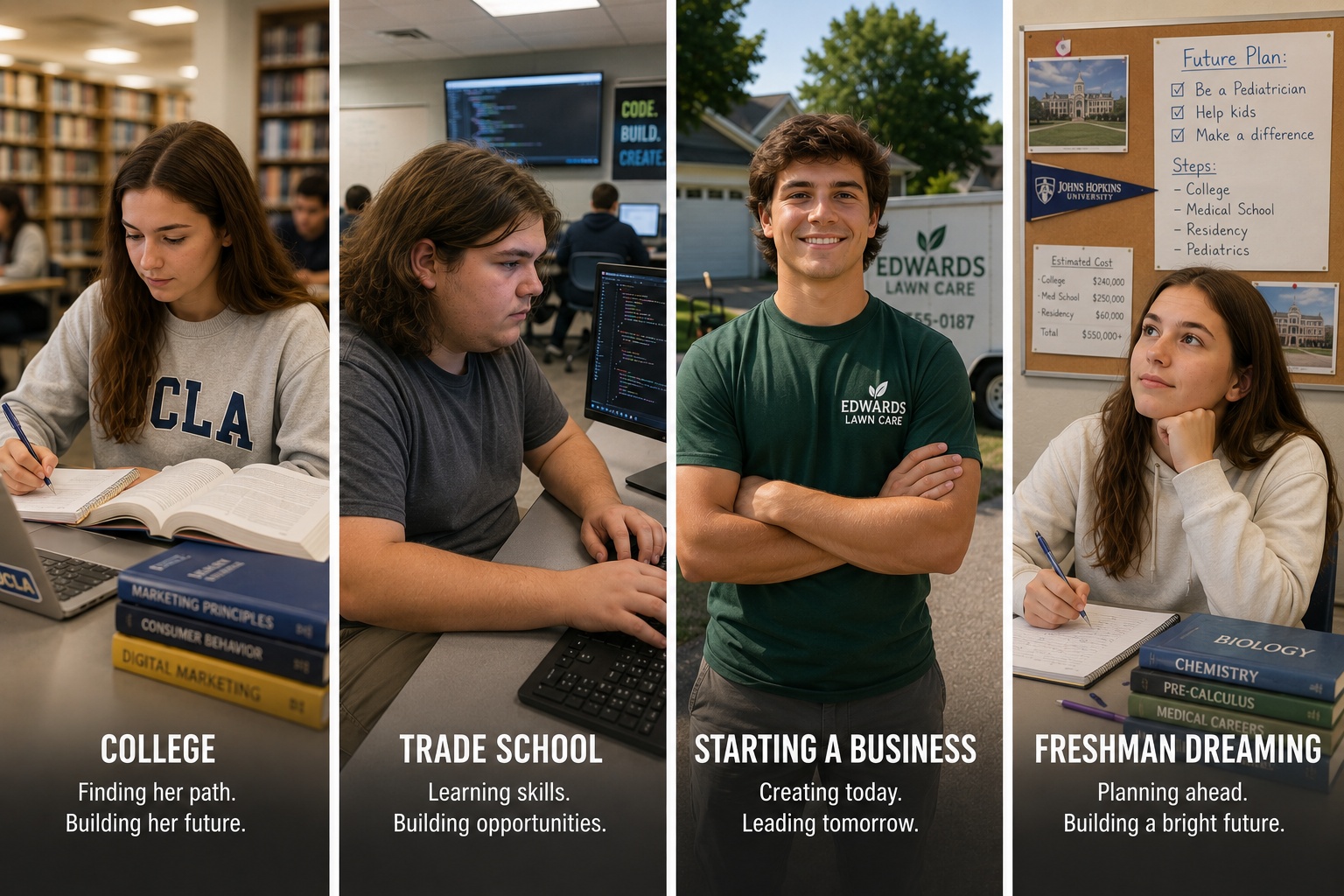
Our oldest daughter is currently attending college. She was a straight-A student throughout school and has always worked incredibly hard. Like many young adults, however, she has discovered that college brings a new level of independence and responsibility. Along with that freedom comes the challenge of discovering who you are and where you belong. She is currently studying marketing, continues working toward her degree, and believes college is still the best path for her—even as she continues exploring exactly where her future fits.
Our oldest son recently graduated from high school. He has high functioning autism and is one of the smartest people I know. His ability to understand complex ideas constantly amazes me. At the same time, he faces challenges that make the traditional college environment less appealing right now. Rather than forcing himself down a path that doesn't currently fit, he is taking time to work, explore opportunities, and discover where his unique talents can best be used. That decision requires courage as well.
Our second-youngest son is a junior in high school and already owns a thriving lawn care business. His dream is to grow that company into something significant before he turns twenty years old. College is not his goal. Instead, he believes attending a trade school while continuing to expand his business will give him practical skills that directly support the future he wants to build. His classroom often includes customers, equipment, employees, and learning through experience.
Our youngest daughter is a freshman in high school, and her future is already remarkably focused. She wants to become a pediatrician. She understands that her dream requires many years of education, and she has already begun researching universities, estimating costs, and looking for scholarships and grants to reduce student debt. Her journey will likely be long, challenging, and incredibly rewarding.
As parents, we are proud of every one of them. Not because they all chose the same path. But because each is working to discover the path that fits who they are.
Parents Should Guide, Not Dictate
My wife and I often remind ourselves that our responsibility is not to design our children's lives. Our responsibility is to prepare them to design their own.
I earned a bachelor's degree. My wife earned a master's degree. Education has been an important part of our lives, and we deeply value learning. At the same time, we recognize that the educational path that worked for us may not be the best path for each of our children.
Our goal is not to create four identical futures. Our goal is to help each child become the best version of themselves.
That means providing guidance while gradually allowing them enough independence to make decisions, experience consequences, adjust course when necessary, and ultimately take ownership of their future.
Questions Every Family Should Ask
Instead of beginning with the question, "Should my child go to college?" consider asking better questions.
· What kind of work excites them?
· Do they enjoy solving practical problems or academic ones?
· Are they energized by working with people, building things, analyzing data, leading teams, or creating businesses?
· Do they learn best through classrooms or hands-on experience?
· What careers genuinely interest them?
· What education is actually required for those careers?
· Could they gain experience through apprenticeships, internships, military service, certifications, or entrepreneurship?
These conversations often reveal far more than simply asking where someone wants to attend school.
A Practical Process for Making the Decision
Families can make these decisions with greater confidence by following a thoughtful process.
1. Discover strengths. Help students identify what they naturally enjoy and where they consistently succeed.
2. Explore careers. Research occupations, interview professionals, shadow workers, volunteer, and gain real-world exposure before making expensive educational decisions.
3. Understand the requirements. Some careers require advanced degrees. Others reward certifications, apprenticeships, portfolios, or practical experience instead.
4. Compare the investment. Consider tuition, opportunity costs, expected earnings, scholarships, grants, apprenticeships, and long-term career satisfaction—not just starting salaries.
5. Create flexibility. Students should know that changing directions is not failure. Many successful adults discover their lifelong careers only after exploring several different paths.
Success Is Bigger Than a Degree
Too often, society measures success by diplomas hanging on a wall. Real success is much broader It is building a meaningful life. Providing for your family. Serving your community. Continuing to learn. Growing in character. Finding work that uses your gifts.
Someone graduating from Harvard Law School may eventually build an extraordinary legal career.
At the same time, a motivated young entrepreneur who starts a successful landscaping company, electrical business, software company, or construction firm immediately after high school may, by the time that law student graduates, already employ multiple people, own valuable assets, and generate significant income.
Neither path is automatically superior. Both require sacrifice. Both require discipline. Both require perseverance. The question is not which path sounds more impressive. The question is which path best matches the student's abilities, goals, and calling.
Learning Never Stops
Whether students attend college, enroll in trade school, begin apprenticeships, join the military, or launch businesses, one principle remains true.
The most successful people never stop learning.
· Books.
· Mentors.
· Podcasts.
· Seminars.
· Certifications.
· Experience.
· Mistakes.
Every opportunity becomes another classroom.
A diploma may mark the completion of one chapter of education, but lifelong learning is what ultimately determines long-term success.
Helping Students Build Their Own Future
As parents and educators, perhaps our greatest responsibility is helping students discover not only what they want to do, but who they want to become. That journey requires patience. It requires listening more than lecturing. It requires encouraging exploration while providing wise counsel. Most importantly, it requires remembering that success does not come from forcing every student onto the same road.
It comes from helping each young person discover the road that best fits their unique talents, passions, character, and purpose. Whether that road leads through a university classroom, a trade school workshop, an apprenticeship, a military base, or the front door of a brand-new business, our greatest joy as parents is not seeing our children follow our footsteps.
It is watching them confidently build lives of integrity, service, fulfillment, and success—on paths that are uniquely their own.
More from the marketplace
- A New Way to See: Photography for Your Homeschool Day — 100cameras, October 16, 2026
- Connect institute of excellence! — Connect institute of excellence, October 16, 2026
- Your Child Isn’t Falling Behind as a Person: They May Just Need a Different Way to Learn — JValenciaACTS, October 15, 2026
- Week 2 - Embrace Mistakes as Learning Opportunities — Classroom Ready Ent. Inc., October 15, 2026
- Step Up For Students: A Complete Guide — eligibility, deadlines and spending rules for Florida families
- Find homeschool vendors — tutoring, curriculum, therapy, STEM, arts and enrichment
Loading the full experience… If it does not appear, this article is fully readable above.